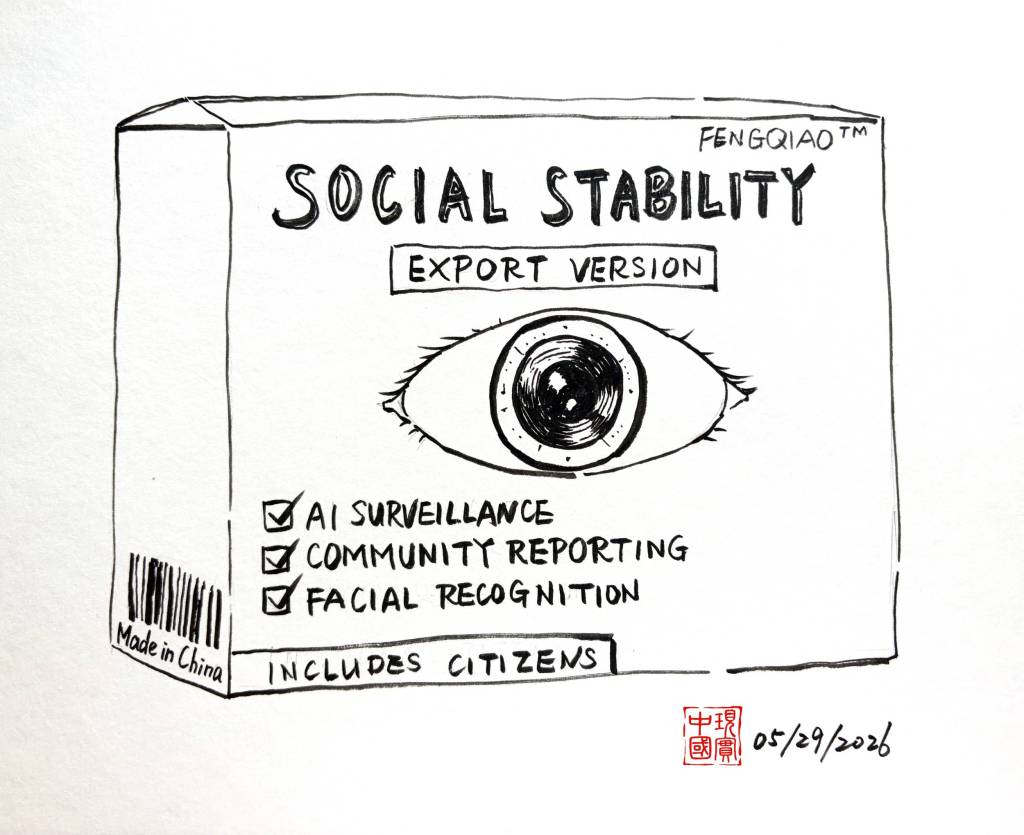
When the Fengqiao Experience Travels Abroad

A recent report describes how China’s “Fengqiao Experience,” a Mao-era model of community surveillance and social control, has been introduced in places as distant as the Solomon Islands. What began as a local request for help with nighttime disturbances in a village near Honiara gradually turned into something far more controversial: proposals to collect fingerprints, household data, and other personal identifiers from residents.

In China, the Fengqiao model emphasizes resolving threats to social order through dense neighborhood monitoring and early intervention. Critics argue it also normalizes extensive state surveillance and the blending of policing with political control.

Its overseas adaptation raises a deeper question: is this simply a tool for public safety, or part of a broader effort to export a governance philosophy centered on state oversight? Supporters describe it as practical assistance for countries with limited policing capacity. Critics, however, warn that such systems may shift the balance between security and personal freedom.

In the Solomon Islands, the pilot program was eventually suspended after public concern. But the experiment highlights a larger global trend—how models of internal governance can travel, adapt, and sometimes collide with local norms.

Click Here for the news report.

The Expansion of Surveillance in Chinese Communities

In a Beijing police station, walls are covered with papers, each representing a building in a large residential area. These papers list residents’ names, phone numbers, and other details, with color codes indicating their risk levels. Green means safe, yellow means to be watched, and orange signifies strict monitoring. A police officer marked a third-floor apartment in yellow, noting its high turnover and labeling it as “high risk” for follow-up.

This meticulous surveillance is a cornerstone of Xi Jinping’s grassroots governance strategy: more visible, invasive, and vigilant against real or perceived threats. Police officers immerse themselves in communities, understanding neighborhood disputes and recruiting retirees as extra eyes and ears. Employers are required to appoint “security advisors” to report regularly to the police.

Historically, the Chinese Communist Party (CCP) has implemented extensive surveillance on activists and dissenters. During the COVID-19 pandemic, this surveillance expanded to track nearly every urban resident. Xi Jinping aims to make this control permanent, embedding the Party deeply into daily life to prevent any disruptions, no matter how minor or non-political.

This approach, known as the “New Era Fengqiao Experience,” revives a method from Mao’s era where citizens were mobilized to publicly shame and control class enemies. Xi frequently references Fengqiao to highlight the Party’s commitment to addressing people’s needs, despite suppressing free speech and dissent.

This strategy aims to strengthen Beijing’s ability to quash dissent amid growing economic challenges and social unrest, solidifying the Party’s control and extending its reach into every aspect of citizens’ lives.