On Friday, Xi Jinping began his new term as President of China, solidifying his position as the country’s most powerful leader in decades.
In 2018, Xi Jinping pushed for a constitutional amendment to remove the two-term limit for the presidency, paving the way for his third term. During that session, three National People’s Congress deputies abstained, and two others bravely opposed the amendment.
Last October, Xi was re-elected as General Secretary. The result of the presidential election, unanimously approved by the legislature controlled by the Chinese Communist Party (CCP), officially confirmed his continued dominance over Chinese politics. He will continue to hold the highest power in the party, military, and government, with no political rivals or prominent potential successors in sight.
As his personal power consolidates, the 69-year-old Xi is positioning himself as the strong leader China needs in a hostile international environment, dismissing criticisms that his authoritarian style is leading the country into more crises.
The CCP’s strict enforcement of the “Zero-COVID” policy has hampered the economy, triggered rare large-scale protests, and heightened investor concerns about China’s long-term growth prospects. Under Xi’s leadership, China’s relations with the West have grown increasingly tense, especially given Beijing’s mounting pressure on Taiwan and its close ties with Russia during the Ukraine war.
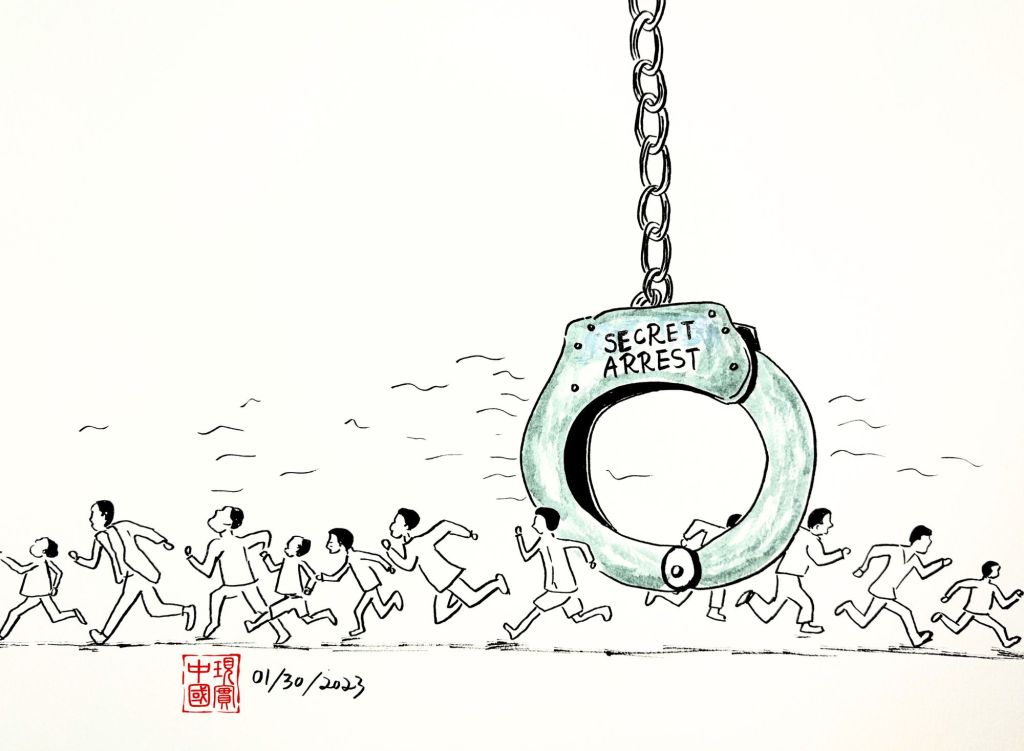
In late November 2022, Beijing saw rare protests against the strict “zero-COVID” policy. The Chinese Communist Party (CCP) quickly responded with its usual tactic of silencing dissent through secret arrests and intimidation, all while attempting to discredit protesters by alleging foreign influence.
The first to be detained were a finance firm employee, a freelance writer, a teacher with a degree in British literature, and an editor at a Beijing publishing house. These four women, friends who shared interests in social issues like feminism and LGBTQ rights, participated in the November protests and were swiftly arrested.
These arrests are part of a broader strategy by the CCP to intimidate and warn those who might be inspired by the recent surge of public discontent. The protests posed a significant challenge to the CCP’s rule and embarrassed President Xi Jinping.
Despite the government’s efforts to keep these actions under wraps, news of the arrests has spread among those involved in the protests. The CCP has avoided officially announcing these arrests to prevent further public outrage but has ensured that the message is clear: even peaceful expression of dissent will not be tolerated, and those who challenge the government face severe personal risks.
The Beijing protests began as a vigil for victims of a deadly fire in Xinjiang, which many blamed on the restrictive “zero-COVID” measures. While initial police response during the protests was relatively restrained, it soon escalated. In the following days, police summoned or visited demonstrators, questioning their participation and connections.
One of the detained women, Cao Zhixin, recorded a video before her arrest, expressing her belief in the right to express opinions even in China. Her case, along with the other three women, has highlighted the personal risks of challenging the government.
Authorities have accused these women of using foreign communication platforms and participating in feminist activities, framing their actions as influenced by foreign forces. The charge of “picking quarrels and provoking trouble,” a vague but commonly used accusation, carries a potential five-year prison sentence.
The CCP’s crackdown on these protesters serves as a stark reminder of the risks of dissent in China. The government’s actions aim to ensure that the recent wave of protests does not inspire further public outcry, using fear and repression to maintain control.
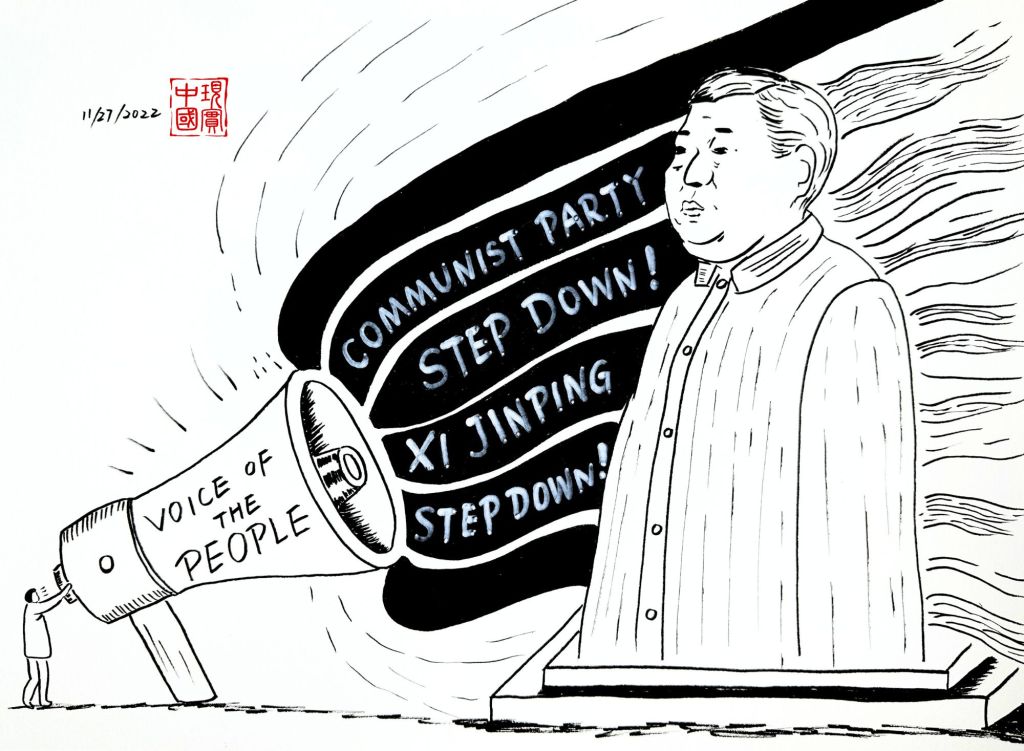
During the spring and summer lockdowns in Shanghai, a young couple refused to go to a quarantine center. When a health worker threatened that it would affect their family for three generations, the young man replied, “We are the last generation.” This statement was seen as an expression of despair. Now, Shanghai’s youth are chanting “We want freedom, we want human rights,” and “Xi Jinping step down, Communist Party step down.” This transformation of grievances into political demands is rare since the 1989 Tiananmen Square protests. The harsh zero-COVID policy of Xi Jinping’s regime has accelerated public resistance.
On November 24, a deadly fire in Urumqi trapped and killed over ten people in their homes. Fire trucks couldn’t get close to the building to extinguish the fire, fueling anger over the zero-COVID policy. The tragedy in Urumqi sparked nationwide protests, led by the youth. In Lanzhou, people overturned COVID testing vehicles, and Nanjing Communication University students gathered to support Xinjiang. The most prominent scene occurred in Shanghai, the economic hub devastated by the lockdown. Videos show that on the night of November 26, predominantly young people gathered on Urumqi Street, laying flowers and candles to mourn the victims. The police confronted them, leading to a standoff. When the police tried to disperse the crowd, the protesters sang “The March of the Volunteers,” China’s national anthem, and chanted “Communist Party, step down! Xi Jinping, step down!”
This scene was unprecedented in China, where anti-government street protests are extremely rare. Despite Xi Jinping reaching the peak of his power at the recent 20th Party Congress, where he eliminated all internal opposition and secured a third term, the Shanghai people demanded his resignation.
The police eventually cleared the area, and videos show people protecting each other and rescuing fellow protesters. Photos shared by the Associated Press show a bus taking away a group of protesters. Although dispersed, their calls for “human rights, freedom” were echoed by students at Peking University and Tsinghua University. In Beijing, protesters at Liangmaqiao chanted slogans in support of Shanghai, and on Sunday, Shanghai residents returned to protest again.
Many wonder why, in such a large country with so many people, there has been compliance with a scientifically unfounded policy solely to satisfy the leader’s will. The answer is fear. Numerous tragedies have occurred this year alone: a nurse in Shanghai was denied emergency treatment at her own hospital, a three-year-old child in Lanzhou died of gas poisoning because his family couldn’t take him to the hospital, and two young women in Guangdong were publicly humiliated for not wearing masks. However, more and more people are refusing to be slaves. The “Superman” hero of Chongqing famously declared, “We have neither freedom nor wealth. We are still struggling with a mild illness.”
In September, a quarantine bus accident in Guizhou killed 27 people, prompting the cry, “We are all on that bus.” The Urumqi fire, which killed ten people, made many realize they could no longer “sit on the train of enslavement.” Three years of violent zero-COVID policies have led to economic decline and hardship. Many migrant workers are homeless, small businesses bankrupt, and youths have wasted their prime years, suffering humiliation and abuse from health workers.
Observers believe the Chinese people are aware of who is behind the cruel zero-COVID policies. By calling for the Communist Party and Xi Jinping to step down, Shanghai residents have shown their intolerable anger towards tyranny. Protests for human rights and freedom are common in most countries, even in autocratic ones like Russia and Iran. However, in China, these actions come with severe consequences, as evidenced by the continuous arrests by the police.
Shanghai’s protests were not isolated, as videos showed solidarity demonstrations in dozens of cities across China on Sunday. In Chengdu, people gathered on Wangping Street and chanted slogans against dictatorship and lifelong rule. Across many places in China, protesters held up blank sheets of paper in silent protest. Some said, “This is our generation’s revolution. We insist on saying what they forbid, insisting on freedom, dignity, and a China that belongs to us!” The blank paper has thus become a symbol of resistance against tyranny.


 The Truth Of China