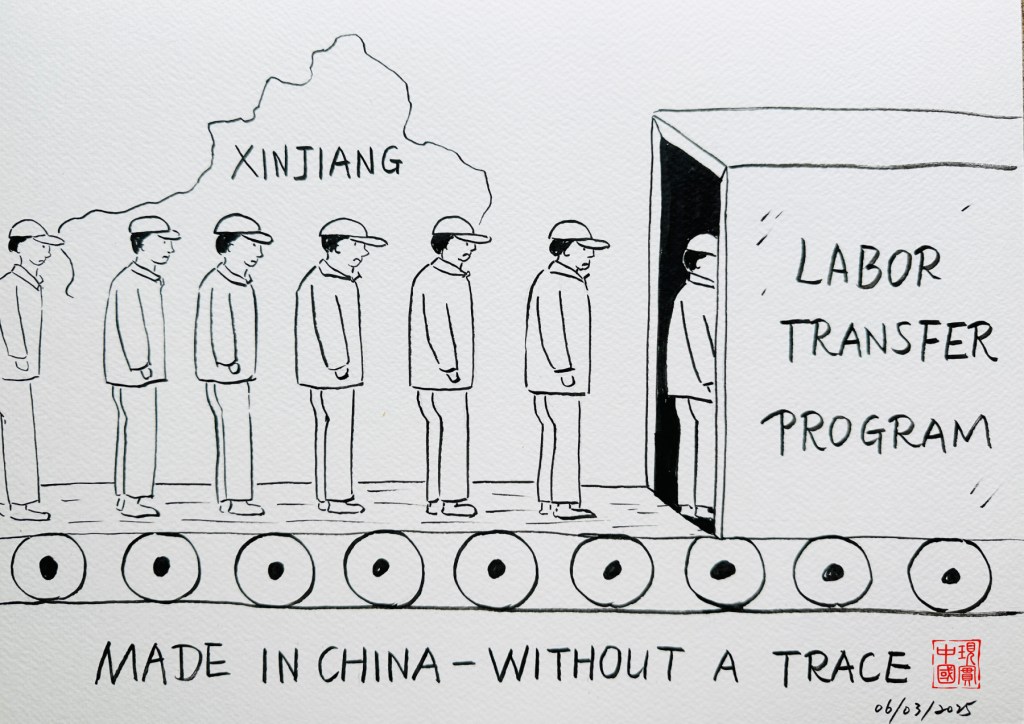
Uyghur Forced Labor Moves Beyond Xinjiang

China’s government has expanded a controversial labor program moving Uyghur workers from Xinjiang to factories across the country. While officials frame these transfers as voluntary employment opportunities aimed at poverty reduction, investigations reveal a more coercive reality. Workers, often leaving home under government supervision, are assigned to factories producing goods for international brands, from appliances to automotive parts.

Reports indicate that tens of thousands of Uyghurs are affected, living in segregated dormitories and monitored closely, with restricted freedom of movement. Despite legal bans in the U.S. and EU on importing goods made with forced labor from Xinjiang, tracking products made outside the region has proven difficult. This loophole allows China to continue supplying global markets while circumventing human rights laws.

Experts warn that these labor transfers are part of a broader strategy of social control, aiming to disperse Uyghur communities and limit cultural expression. 

Click here for related report.

The Expansion of Surveillance in Chinese Communities

In a Beijing police station, walls are covered with papers, each representing a building in a large residential area. These papers list residents’ names, phone numbers, and other details, with color codes indicating their risk levels. Green means safe, yellow means to be watched, and orange signifies strict monitoring. A police officer marked a third-floor apartment in yellow, noting its high turnover and labeling it as “high risk” for follow-up.

This meticulous surveillance is a cornerstone of Xi Jinping’s grassroots governance strategy: more visible, invasive, and vigilant against real or perceived threats. Police officers immerse themselves in communities, understanding neighborhood disputes and recruiting retirees as extra eyes and ears. Employers are required to appoint “security advisors” to report regularly to the police.

Historically, the Chinese Communist Party (CCP) has implemented extensive surveillance on activists and dissenters. During the COVID-19 pandemic, this surveillance expanded to track nearly every urban resident. Xi Jinping aims to make this control permanent, embedding the Party deeply into daily life to prevent any disruptions, no matter how minor or non-political.

This approach, known as the “New Era Fengqiao Experience,” revives a method from Mao’s era where citizens were mobilized to publicly shame and control class enemies. Xi frequently references Fengqiao to highlight the Party’s commitment to addressing people’s needs, despite suppressing free speech and dissent.

This strategy aims to strengthen Beijing’s ability to quash dissent amid growing economic challenges and social unrest, solidifying the Party’s control and extending its reach into every aspect of citizens’ lives.