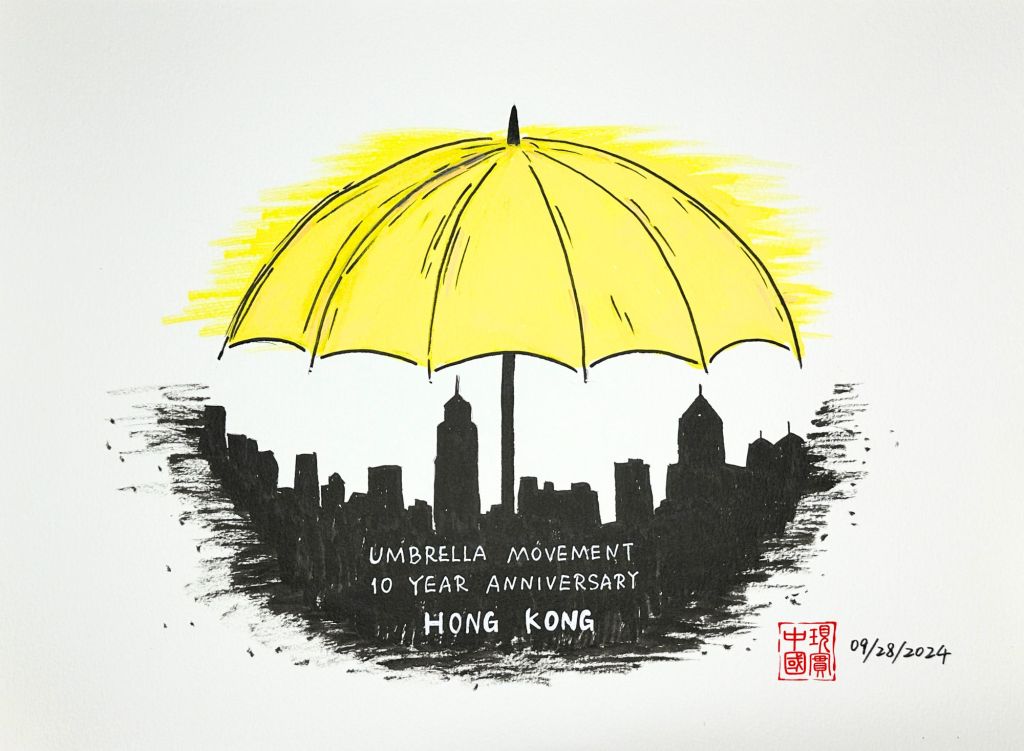
Ten years ago, Hong Kong witnessed a remarkable chapter in its history—the Umbrella Movement. What began as a call for democratic reforms and universal suffrage swiftly grew into a powerful symbol of peaceful resistance. Thousands of citizens, armed only with umbrellas to shield against tear gas, united in a non-violent stand for their rights.
The spirit of the movement has left an indelible mark on the city. Though the physical barricades have long been dismantled, the ideals of democracy, freedom, and autonomy continue to inspire. The Movement’s legacy lives on through the resilience of Hong Kongers who strive for justice, despite facing increasing challenges and suppression.
As we commemorate this anniversary, we honor the courage and determination of those who stood on the front lines and reflect on the ongoing struggle for democracy. The Umbrella Movement reminds us that the fight for freedom is enduring, and the hope for a brighter, more democratic future remains alive in the hearts of many.
Here’s to remembering the past, acknowledging the present, and hoping for a future where the spirit of the Umbrella Movement thrives.
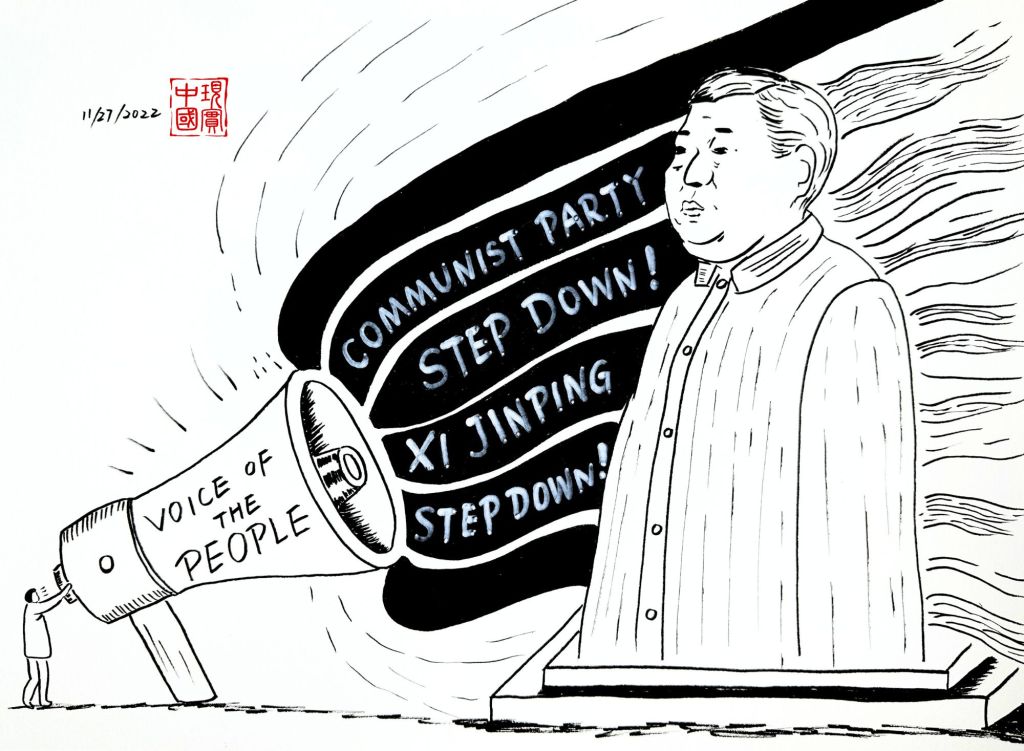
During the spring and summer lockdowns in Shanghai, a young couple refused to go to a quarantine center. When a health worker threatened that it would affect their family for three generations, the young man replied, “We are the last generation.” This statement was seen as an expression of despair. Now, Shanghai’s youth are chanting “We want freedom, we want human rights,” and “Xi Jinping step down, Communist Party step down.” This transformation of grievances into political demands is rare since the 1989 Tiananmen Square protests. The harsh zero-COVID policy of Xi Jinping’s regime has accelerated public resistance.
On November 24, a deadly fire in Urumqi trapped and killed over ten people in their homes. Fire trucks couldn’t get close to the building to extinguish the fire, fueling anger over the zero-COVID policy. The tragedy in Urumqi sparked nationwide protests, led by the youth. In Lanzhou, people overturned COVID testing vehicles, and Nanjing Communication University students gathered to support Xinjiang. The most prominent scene occurred in Shanghai, the economic hub devastated by the lockdown. Videos show that on the night of November 26, predominantly young people gathered on Urumqi Street, laying flowers and candles to mourn the victims. The police confronted them, leading to a standoff. When the police tried to disperse the crowd, the protesters sang “The March of the Volunteers,” China’s national anthem, and chanted “Communist Party, step down! Xi Jinping, step down!”
This scene was unprecedented in China, where anti-government street protests are extremely rare. Despite Xi Jinping reaching the peak of his power at the recent 20th Party Congress, where he eliminated all internal opposition and secured a third term, the Shanghai people demanded his resignation.
The police eventually cleared the area, and videos show people protecting each other and rescuing fellow protesters. Photos shared by the Associated Press show a bus taking away a group of protesters. Although dispersed, their calls for “human rights, freedom” were echoed by students at Peking University and Tsinghua University. In Beijing, protesters at Liangmaqiao chanted slogans in support of Shanghai, and on Sunday, Shanghai residents returned to protest again.
Many wonder why, in such a large country with so many people, there has been compliance with a scientifically unfounded policy solely to satisfy the leader’s will. The answer is fear. Numerous tragedies have occurred this year alone: a nurse in Shanghai was denied emergency treatment at her own hospital, a three-year-old child in Lanzhou died of gas poisoning because his family couldn’t take him to the hospital, and two young women in Guangdong were publicly humiliated for not wearing masks. However, more and more people are refusing to be slaves. The “Superman” hero of Chongqing famously declared, “We have neither freedom nor wealth. We are still struggling with a mild illness.”
In September, a quarantine bus accident in Guizhou killed 27 people, prompting the cry, “We are all on that bus.” The Urumqi fire, which killed ten people, made many realize they could no longer “sit on the train of enslavement.” Three years of violent zero-COVID policies have led to economic decline and hardship. Many migrant workers are homeless, small businesses bankrupt, and youths have wasted their prime years, suffering humiliation and abuse from health workers.
Observers believe the Chinese people are aware of who is behind the cruel zero-COVID policies. By calling for the Communist Party and Xi Jinping to step down, Shanghai residents have shown their intolerable anger towards tyranny. Protests for human rights and freedom are common in most countries, even in autocratic ones like Russia and Iran. However, in China, these actions come with severe consequences, as evidenced by the continuous arrests by the police.
Shanghai’s protests were not isolated, as videos showed solidarity demonstrations in dozens of cities across China on Sunday. In Chengdu, people gathered on Wangping Street and chanted slogans against dictatorship and lifelong rule. Across many places in China, protesters held up blank sheets of paper in silent protest. Some said, “This is our generation’s revolution. We insist on saying what they forbid, insisting on freedom, dignity, and a China that belongs to us!” The blank paper has thus become a symbol of resistance against tyranny.
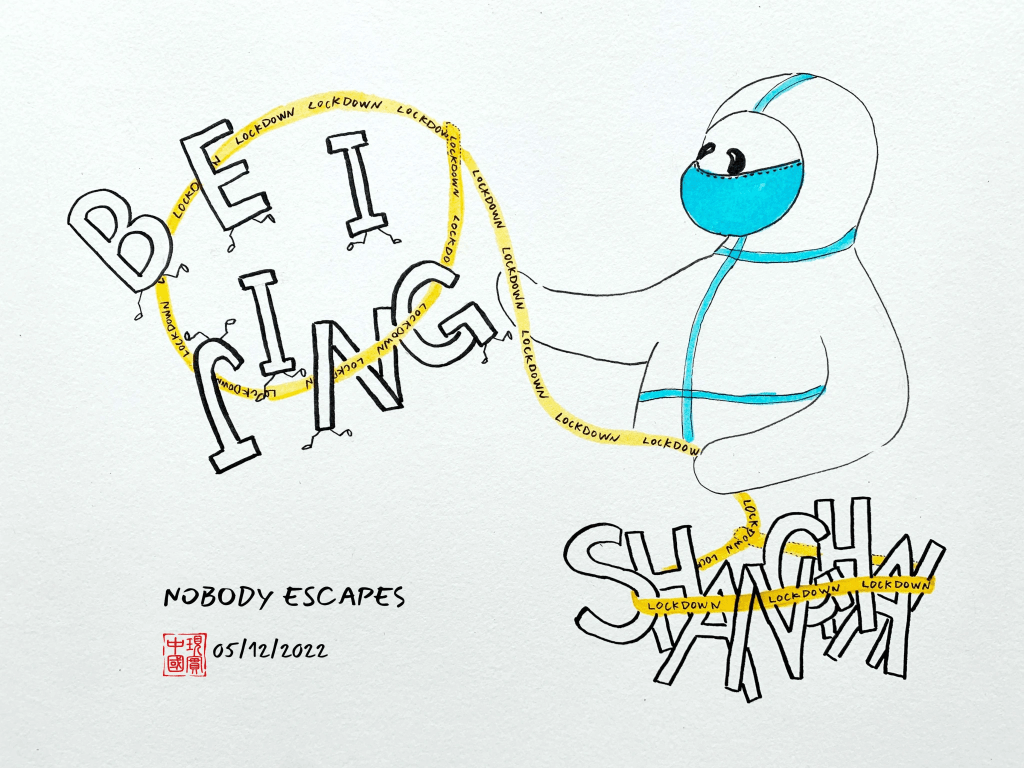
China has stopped renewing passports and issuing new ones to Chinese citizens since July 30, 2021. However, that’s not enough for the government to crack down on people escaping the country. Today China just announced it will strict limit unnecessary overseas travel for Chinese citizens to prevent the virus being brought into the country.
“Don’t go out unless necessary, don’t leave the country unless necessary, don’t be born unless necessary,” one popular comment in reaction to the news on Weibo, a Chinese social media like Twitter.
While witnessing the chaos and dysfunction in the lockdown of Shanghai, fears rise over new government-enforced lockdowns — especially in the capital Beijing, where Covid cases are rising.
Today’s announcement of travel ban extinguished the hope to escape for those who still hold valid passports.
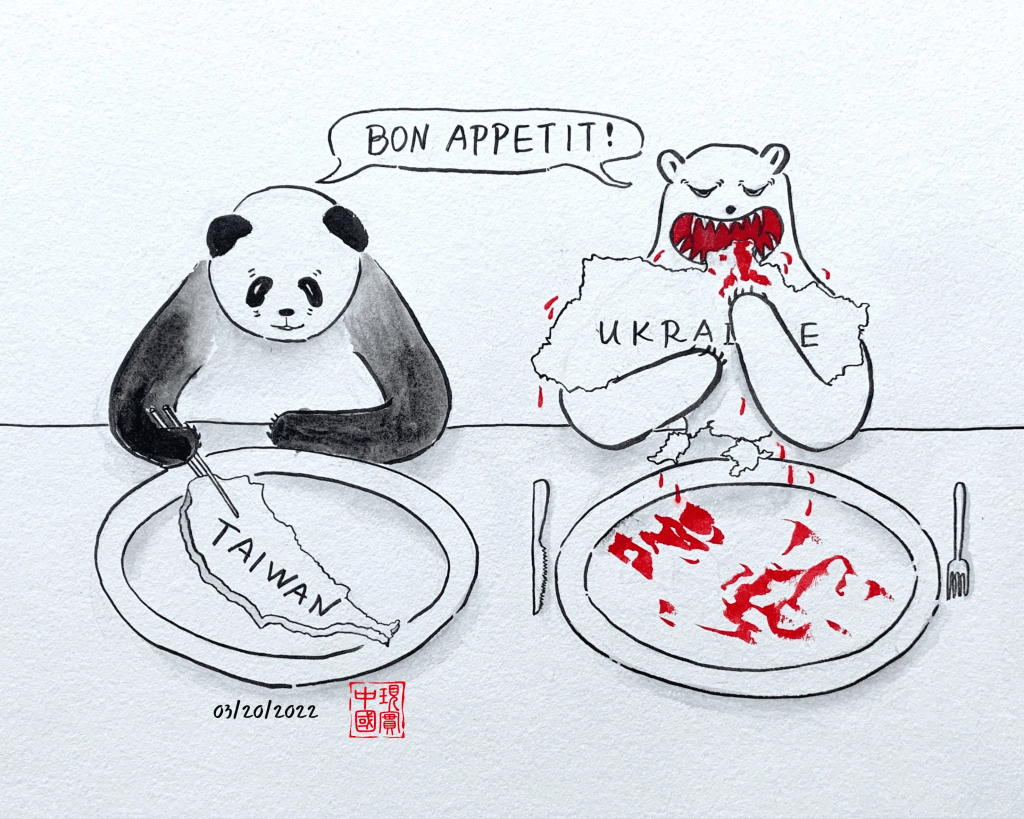
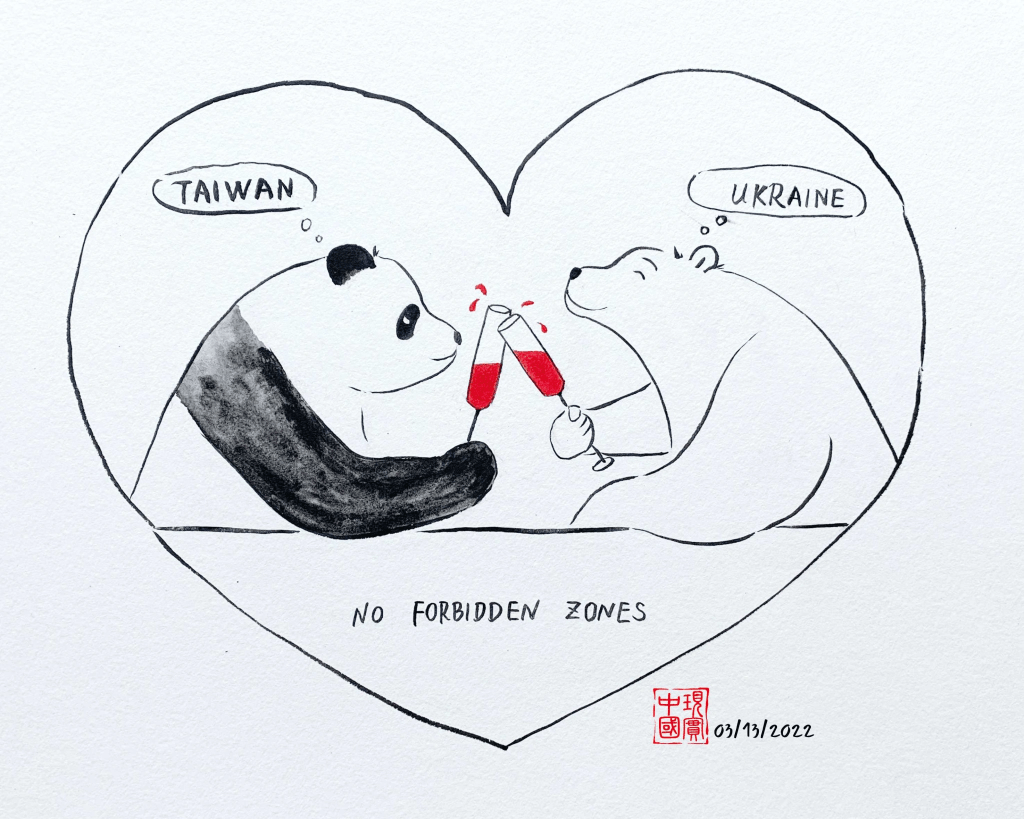
China is watching all those international sanctions on Russia, and opposition and protests against Putin’s invasion of Ukraine, Putin’s power is being challenged like never before. Will China have a second thought about force unification of Taiwan?
As Russia-Ukraine war escalates, China is on pins and needles, as Xi and Putin just issued a joint statement saying that the relationship between China and Russia has “no forbidden zones”.
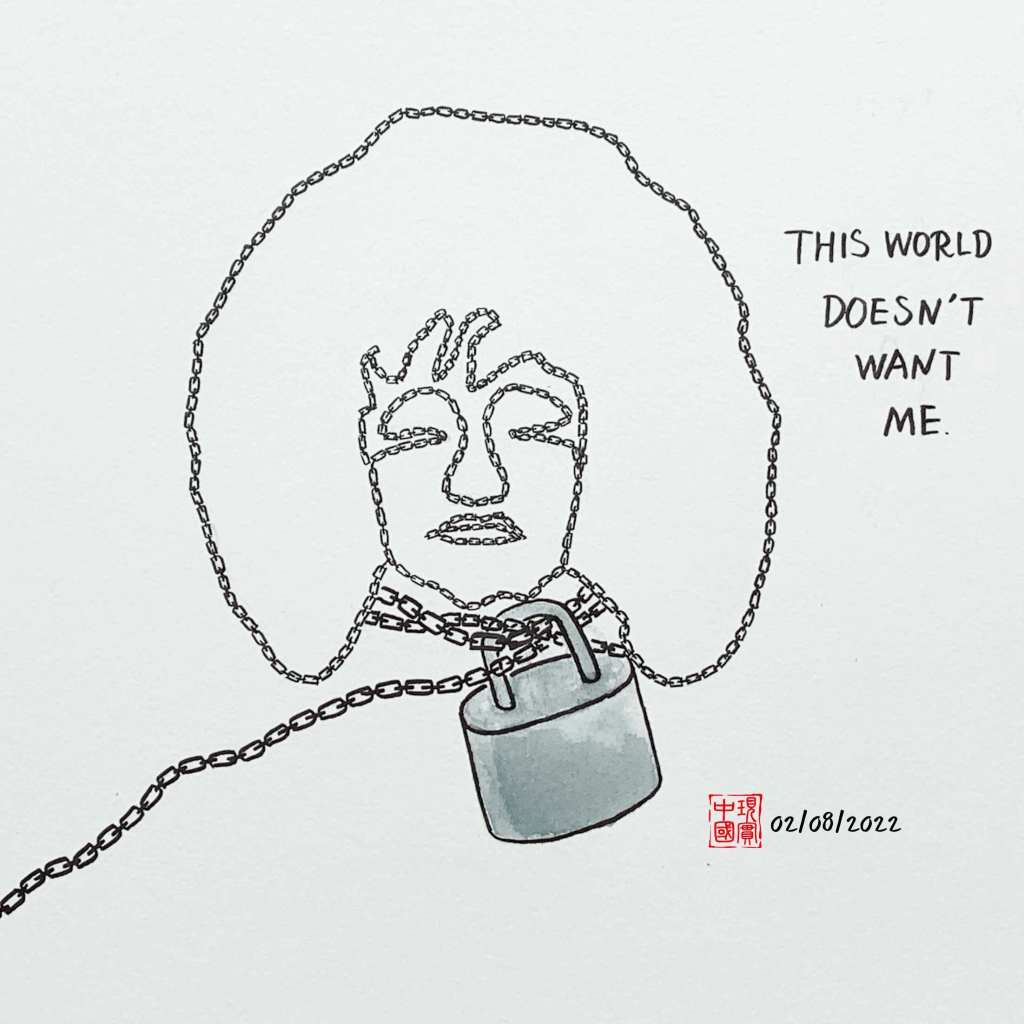
As China’s Winter Olympics presents a picture of peace and prosperity, a TikTok video revealed a woman chained around her neck, secured with a lock and affixed to the wall in a shack that opens up to the exterior. She wears a light sweater despite the January cold and looks haggard and her hair hangs lankly.
“This world doesn’t want me,” the woman can be heard saying.
Netizens has been calling for justice: Who really is she? Who and why chained her? Had she been abused or trafficked, like being sold as a bride under fraud or coercion? How had she managed to birth eight children under strict national birth policies that until 2016 had restricted families to only one child?
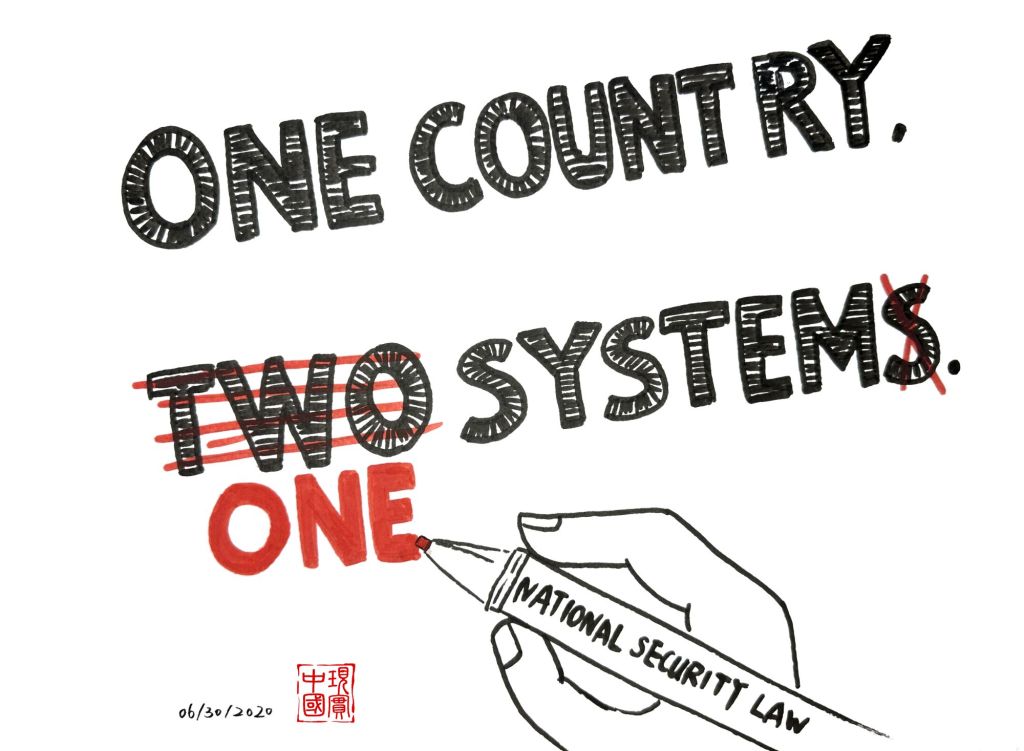
On June 30, 2020, the Standing Committee of the National People’s Congress of China passed and implemented the “Law of the People’s Republic of China on Safeguarding National Security in the Hong Kong Special Administrative Region,” commonly referred to as the Hong Kong National Security Law (NSL). The introduction of this law in Hong Kong has sparked intense controversy, as it is widely seen as a severe breach of the “one country, two systems” principle that was meant to guarantee Hong Kong’s high degree of autonomy and its own legal system for 50 years following the 1997 handover.
The implementation of the Hong Kong National Security Law marks a significant turning point in the city’s history, raising profound concerns about the future of its freedoms, autonomy, and the rule of law.
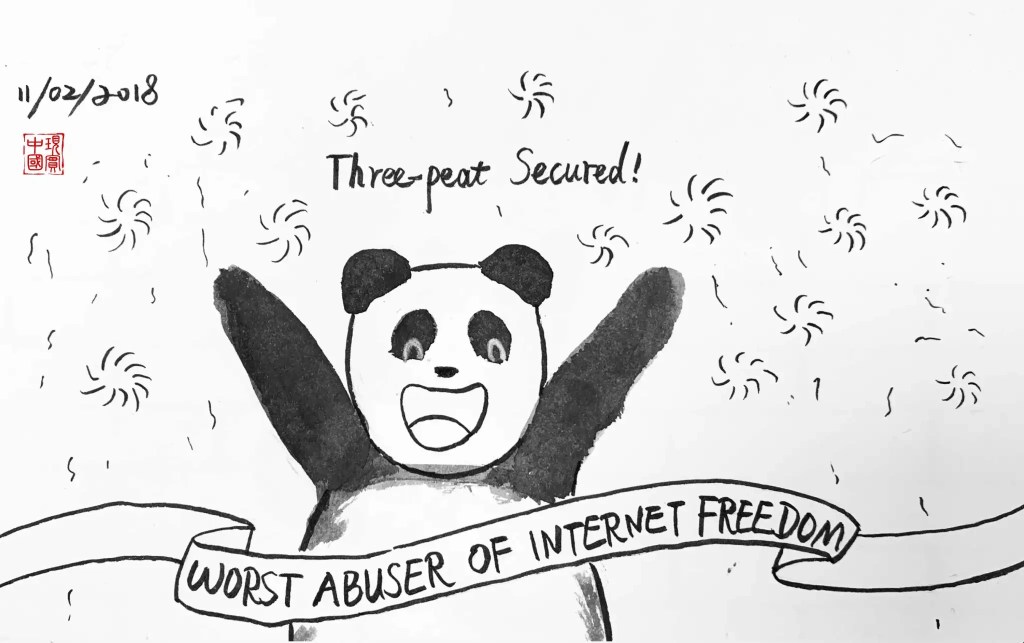
China is ranked as the World’s Worst Abuser of Internet Freedom for the third consecutive year, says the “Freedom on the Net 2018: The Rise of Digital Authoritarianism” report that was issued by Freedom House, a Washington-based think tank conducting research on advocacy and democracy.
According to the report, Internet controls within China reached new extremes in 2018 with the implementation of the sweeping Cybersecurity Law and upgrades to surveillance technology. The law centralizes all internet policy within the Cyberspace Administration of China (CAC), strengthens obligations for network operators and social media companies to register users under their real names, requires that local and foreign companies work to “immediately stop transmission” of banned content, and compels them to ensure that all data about Chinese users is hosted within the country. The Cybersecurity Law has been followed by hundreds of new directives—an average of nearly one every two days—to fine-tune what netizens can and cannot do online. Among other steps, authorities have cracked down on the use of VPNs to circumvent the Great Firewall, leading Apple to delete hundreds of the services from its local app store.

 The Truth Of China